

Didn’t Get Your IELTS Score? How to Improve and Succeed Next Time
Most students who take the IELTS exam hope to achieve their target band score on the first attempt. Unfortunately, this does not happen for everyone. In reality, only a small percentage of test-takers manage to reach higher band scores, such as Band 7 or above. For example, in countries like India, achieving a Band 7 places you among a relatively small group of candidates.
So what should you do if your results are not what you expected?
There is no quick fix or secret formula, but there is a clear and practical way to recover, improve, and move forward. Below are five important steps to help you deal with an IELTS result that didn’t go as planned and prepare more effectively for the future.
1. Give yourself time to be angry and upset.
Opening your IELTS results and realizing you didn’t reach your target score can be extremely frustrating. You may feel upset because you invested time, money, and effort into preparation, only to feel like you are starting over again.
This reaction is completely normal.
Give yourself a few days to feel disappointed or even angry. Trying to ignore these emotions often makes things worse. Once those initial feelings settle, it becomes much easier to think clearly and objectively.
After that, review your results carefully. Look at each section—Listening, Reading, Writing, and Speaking. Did you meet your target in any of them? If yes, that is a positive sign and something you should continue to build on. If not, this is the moment to focus on understanding why the score fell short and what can be improved.
2. Don’t punish yourself
Failing to reach your IELTS goal does not mean you are weak in English or incapable of success. IELTS is a challenging exam, and in many countries the average band score is around 6.0 to 6.25.
It is also important to understand how demanding higher scores really are. For example, if you are aiming to migrate to Canada, you may need CLB 9, which translates to scores like 8.0 in Listening and 7.0 in the other sections. These scores place candidates among the top performers worldwide. Achieving them is difficult, especially in Writing and Speaking.
Never allow yourself—or anyone else—to make you feel embarrassed or ashamed because of your IELTS result. Many successful candidates needed more than one attempt. Progress in language learning is not always fast, but it is possible with the right approach.
3. Honestly Analyse Why You Didn’t Reach Your Target
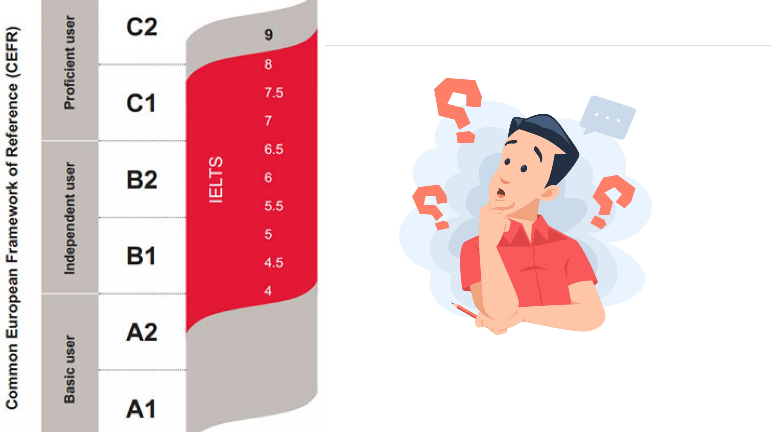
This is one of the most important steps. You need to evaluate your performance honestly and realistically.
If your overall band score is around 6.5 or 7.0, but your goal is much higher (such as 8 or 7.7), this usually means your current English level is around B2. At this level, immediately booking another IELTS test is often not the best decision.
Instead of rushing into another exam:
- Do not waste money on repeated test attempts
- Do not jump straight back into IELTS practice
At this stage, improving your general English skills is more important than practicing test questions. Working with a qualified English teacher can help you strengthen your language foundation before you attempt the exam again.
Ask yourself the following questions honestly:
- Did I have a positive or negative mindset while preparing?
- Was I calm and focused before the test began?
- Did I understand the essay question clearly in Writing Task 2?
- Did I stay on topic while writing?
- Did I manage my time well in Reading and Writing?
- Was I feeling stressed or rushed toward the end of the exam?
- Did I struggle with the Speaking Part 2 or Part 3 topics?
If attitude, stress, or lack of strategy played a role, professional guidance can make a big difference. There is little benefit in booking another IELTS test until you are confident that these problems have been addressed.
If your main difficulties are Writing or Speaking, getting expert feedback is especially important. A skilled teacher can analyse your performance in detail and clearly explain what is holding your score back. At London House of Careers, for example, writing assessments focus on identifying specific weaknesses so students know exactly what to improve.
4. Get Back on the Right Track
Repeating the IELTS exam again and again without fixing underlying issues often leads to frustration, wasted money, and loss of motivation. Over time, this cycle can cause students to feel discouraged and even give up on their goals.
Instead, shift your focus toward real improvement.
Work on strengthening your core skills—reading, listening, speaking, and writing—before retaking the test. Targeted courses and guided practice can help you develop the techniques and confidence needed to handle IELTS tasks effectively.
Progress may feel slow at first, but steady improvement is far more valuable than repeated test attempts without preparation.
Focus on getting up and improving your skills.
5. Try again with a Better Strategy
Think of learning English like learning to ride a bicycle. Almost everyone falls the first time. What matters is learning how to balance before trying again.
In IELTS terms, “learning to balance” means improving your language skills and understanding the test requirements properly. When your English level improves, achieving your target band score becomes much more realistic and less stressful.
Determination, patience, and the right preparation strategy make a huge difference.
6. Create a Clear Action Plan
Take a break if you’re feeling tired and depressed by your IELTS journey, then make a study plan by using your answers from the assessment of why you failed. This information can then be transferred into a study plan.
For example, you can create a plan shown below:

REMEMBER – It’s important that your action plan should:
- Focus on your weakest skills
- Include realistic daily or weekly goals
- Balance language improvement and exam practice
- Allow time for review and feedback
By turning your mistakes into a structured plan, you move from frustration to control. This approach not only improves your chances of success but also makes your IELTS journey far more manageable.
If you follow these steps, then hopefully you will get the band score that you desire and bring back joy in your life!
Final Thoughts
Not getting your desired IELTS score can be disappointing, but it does not define your ability or your future. Many successful candidates faced the same situation before finally reaching their goals.
With honest reflection, proper guidance, and a clear plan, improvement is absolutely possible. Treat this experience as a learning step—not the end of the road.