

Understanding the IELTS Speaking Test
The IELTS speaking test is face-to-face interview with a trained examiner that lasts between 11 and 14
minutes. The interview is recorded, and if you take the test for UK visa purposes (IELTS- UKVI), it will be videoed.
If you are planning for computer delivered IELTS test, you will still have a face-to-face interview with an examiner.
There is only one speaking test for all candidates. Academic and General
The speaking test recording allows for your marks to be checked and to ensures that each examiner follows the standard procedures for the test. So, don’t be afraid thinking that the recording is for you! This means that the examiner must strictly follow the timing for each part of the test, and ask questions that will allow you to show your range language from familiar to unfamiliar as you can below:
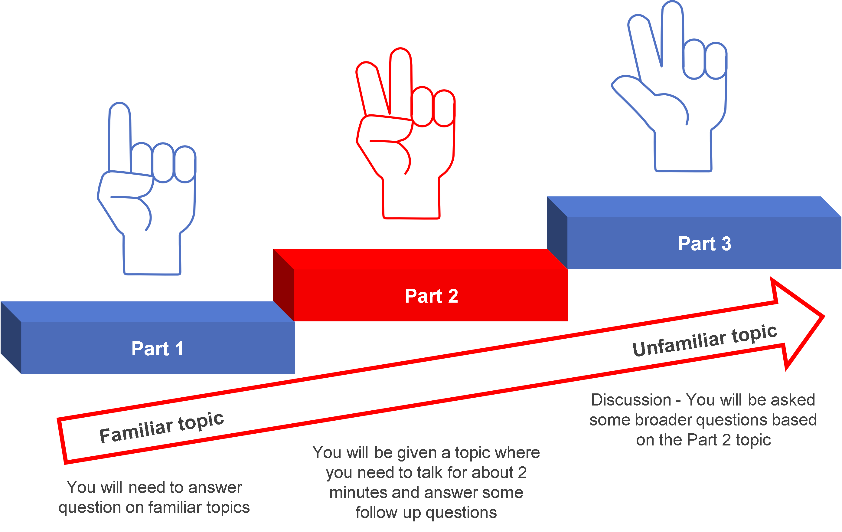
Remember Speaking is even more personal than writing, and the idea of a speaking test if for the examiner to make you feel comfortable and at ease. They also have to give you every
opportunity to show your speaking ability. But, it is your job to show the examiner that you can speak both naturally and fluently
The best way to approach the speaking test, is by:
- Understanding the Format of the Speaking test – Parts 1, 2 & 3
- The 4 key skills you’ll be assessed on
- Understand the main reason for low scores
- Avoiding this big mistake
Format of the IELTS Speaking Test
The Speaking test is the same for both the Academic and the General IELTS exams.
It could be on the same day as your Writing, Listening and Reading tests, which are taken together, or 7 days before or after them. All tests are recorded.
The Speaking Test lasts for 11-14 minutes and is made up of three parts.
IELTS Speaking Test – Part 1
Time: 4-5 minutes.
You will be asked questions about you and your life. They could include anything connected with the following topics:
- Your work or study
- Your home
- Your family
- Your home town
- Your likes or dislikes
These questions will be easy to answer as you obviously know all about yourself and your life.
You cannot give a wrong answer so try to relax and treat this as a warm-up for the rest of the test.
IELTS Speaking Test – Part 2
Time: 3-4 minutes.
The examiner will give you a cue card with a topic written on it, along with 3-5 bullet points telling you what to include in your talk.
You will be asked to speak on this topic for up to 2 minutes. The examiner may then ask you 1 or 2 questions about your topic.
You'll be given 1 minute for preparation during which time you are allowed to make notes.
The topic can be almost anything but will, again, be related to you in some way, for example:
- something about you
- something that has happened to you
- something you have experienced
Here’s an example of a cue card.
Describe a party you have been to.
You should say:- whose party it was
- whose party it was
- who was there
TThe topic is stated in the first sentence. In this case, it’s ‘a party’.
The 3 bullet points and final clause are a guide as to what you should talk about but you don’t have to stick rigidly to them. I explain more about this on the page dedicated to Part 2 questions. You’ll find it here:
IELTS Speaking Test – Part 3
Time: 4-5 minutes.
The examiner will ask you questions related to the topic on your cue card that you discussed in Part 2. These questions will be more abstract in nature to encourage you to explore ideas and concepts rather than just relating facts.
You will be This will be more of a dialogue between you and the examiner which will give you the opportunity to express your thoughts and feelings about the topic or to develop your ideas.
For this party topic, they will be questions such as:
- When do people usually have parties in your country?
- What makes a good party?
- How important is it to celebrate important events with a group of people?
- Why do some people not enjoy going to parties?
- How do people in your country usually mark the New Year?
- Do you think that festivals or celebrations are over-commercialised or have lost their original meaning?

Why People Get a Low Score & How to Avoid This Big Mistake
One of the main reasons people get a low score for their IELTS Speaking test is that they don’t understand what is actually required. They might think they do, but they don’t. So let’s sort this out right now to give you the best chance of a high score.
This is so important. After all, if you don’t know what the examiner wants, how can you give it to them?
I’ll start by making it clear what the Speaking test is not.
- It is not a test of your knowledge or your intelligence.
- You are not expected to be an expert on the subjects they ask you about.
- You won’t be assessed on the content of what you say.
- Why do some people not enjoy going to parties?
- The examiner doesn’t care what you do or do not know.
They just want to hear your opinions and how well you communicate them. That’s it.
You are not expected to have lots of knowledge on the subjects you’re asked about. You’re not taking a Masters Degree, you’re taking an English speaking test. The content of what you say is not important and you won’t be assessed on it. You can even make something up if you need to.
With that out the way, let’s have a look at what you will be assessed on.
The examiners follow strict marking criteria. If you want to see them, click this link for a PDF download of the official Speaking Test Assessment Criteria. It includes the criteria for all nine band levels in each of the four skill areas
If you do decide to check them out, don’t be overwhelmed. They’re not as complicated as they might at first appear. Here they are in summary.
The IELTS Speaking test is designed to assess your ability to:
- communicate opinions and information on everyday topics and common experiences
- speak at length on a given topic using appropriate language
- organise your ideas coherently
- organise your ideas coherently
- organise your ideas coherently.
There are just four key skills that you will actually be marked on and these are what we’ll look at next.

The 4 Key Skills You’ll Be Assessed On
So what, specifically, are you tested on? Just these four things:
- Fluency and Coherence
- Vocabulary
- Grammar
- Pronunciation
These are all you need to worry about. They each hold 25% of the marks.
Fluency & Coherence
Fluency – the ability to speak easily, naturally and at a good speed without lots of stops, pauses or repetition.
Coherence – The way that ideas are organised, developed and connected so that they flow from one to the other logically and what is said makes sense.
Both are important.
Vocabulary
To do well in the test, you need to demonstrate the ability to correctly use a wide range of vocabulary.
I’ve highlighted the words ‘correctly’ because many people make the mistake of thinking that they just have to throw in lots of ‘advanced’ and ‘complex’ words to get a high score for vocabulary.
The result is speech that’s full of inappropriate vocabulary, used incorrectly, and sentences that are difficult to understand. That’s the perfect recipe for a low mark.
The examiner doesn’t want you to try and be clever and include the most advanced vocabulary you can possibly think of. They want you to use the right or most appropriate words and phrases to answer the question.
You don’t want to sound like a university professor giving a lecture, just a normal person talking in everyday language. This is so important.
I’ve created a whole section on the website to help you with vocabulary, including topic words lists and practise questions with sample answers. Start exploring it here: IELTS Vocabulary
Grammar
Here are 3 important points concerning grammar:
- Most people try to overcomplicate grammar.
- Use the most appropriate language to answer each question.
- The questions are designed to assess your ability to use different tenses.
Most people try to overcomplicate grammar. Yes, you need to understand and correctly use the different tenses in the English language. Indeed, the questions you’ll be asked are designed to test your ability to use a range of verb tenses and other grammatical structures.
However, as with everything else in the IELTS Speaking test, you need to be able to use the most appropriate language for any given question. The examiner won’t be impressed if you try to use three different tenses in your answer, just to show that you can, when they really don’t belong there. Your speech will automatically lose coherence and you’ll thus lose marks.
Pronunciation
The most important aspect of pronunciation to get right is clarity, which is being clear and easy to understand. If the examiner can’t understand you when you talk, they’ve no way of assessing your English language skills.
The clarity of your speech is determined to a large extent by these five features of pronunciation:
- individual sounds
- word stress
- sentence stress
- connected speech
- intonation
Major grammar errors and incorrect vocabulary will also, of course, make it more difficult to understand you, but good pronunciation enables you to show off all your other language skills.
So now that you know exactly what the examiner will be looking for when you take your exam, you’re already better prepared than most people.
IELTS-Style Practice Speaking Questions
The best way to prepare for your IELTS Speaking test is to practise answering lots of IELTS-style questions.
You'll find plenty of these on the website. I've included practice questions on each of the topic vocabulary pages to help you learn the appropriate vocabulary at the same time.
Choose which topics you'd like to work on via these links:












Common problems in IELTS speaking
As with all of the previous papers, to improve your score in speaking, you need to begin by identifying your problems and then working on them. In my experience, people remain stuck at band 6 in speaking because of three main issues: key misunderstandings about the test; a lack of awareness of language problems; and a lack of opportunities to practise. Let us begin by looking at some common misunderstandings.
Why is the speaking test becoming more difficult each year?
A few years ago, I gave a talk to a group of teachers in China. To be able to continue in their role, the teachers had to take IELTS each year and achieve a high score. Many had managed to reach band 8 in speaking. One such teacher was concerned that her own students would struggle to answer the questions the examiner posed during her annual test. In fact, she was convinced the test was getting more and more difficult each year.
On any test day, the examiners will assess candidates of a wide range of levels. They are trained to adjust their questions so that each candidate feels comfortable and able to answer. But, in order to help them reach their language peak, each candidate will at some point be given questions they find more difficult. It would be very unfair if a band 3 candidate was asked the same test questions as a band 9 candidate. It would be equally unfair if the band 8 teacher was asked only basic questions and, as a result, did not have the opportunity to show the full extent of her skills.
So, the teacher was correct in thinking that her speaking test was becoming more difficult each year: as her language level developed, the examiners adjusted their questions accordingly. But she was incorrect in assuming that her lower-band students would be given the same questions.
Pauline Cullen © 2017 Do not copy individual parts of this book. All rights reserved
‘At the beginning, the examiner seemed rude’
This is another comment I heard from the teachers. Having trained many oral examiners and worked as a Cambridge examiner myself for many years, I was very puzzled by the comment. It transpired that some of the teachers helped their students to learn answers for the test, which poses a problem for the examiner.
This is not a test of your ability to learn answers, but a test of how well you can communicate your ideas when speaking naturally. To the examiner, a learned answer is as obvious as if you were to get up and stand on your chair to try to appear taller. When the examiner hears answers like this, they must quickly interrupt you and ask a new question.
Those who prepare answers generally do so for part 1 questions, which focus on familiar topics. This part of the test should be a gentle introduction that helps you adjust to what can feel like a stressful situation. However, if the examiner has to repeatedly interrupt your answers and change the topic, this instead creates a very frustrating start to the interview.
If you give prepared answers, you are cheating yourself of a key part of the test when you should generally be able to respond the most confidently. If the examiner interrupts you to ask a new question, they are not being rude; they are trying their best to give you a fresh start, and a new chance to answer naturally.
The candidate’s role
Your examiner will try their best to make your speaking test feel like a natural conversation, but this requires your cooperation. The candidate’s role is to engage with the examiner by listening attentively to their questions and answering them naturally.
Listening plays a key part in any conversation, and it is only by listening well that we can respond appropriately. For example, you should always pay close attention to the tense that the examiner uses.
As we have seen, the examiner will try to give you plenty of opportunities to show the full extent of your language and skills. In part 1, this can include asking you about past, present, or future events, while in part 3, you may be asked about the causes of something or about what you think should or might happen as a result of something.
So, listening well can help you show a wide range of language in your answers. Good course books will help you to practise each of these.
If you are a shy person, try to see yourself as helping the examiner; be polite, friendly, and answer the questions fully. This means giving a complete answer rather than short responses of one or two words.
I always advise people to approach the speaking test as they would a job interview. You do not need to go as far as to dress formally, or wear a suit and tie. Nevertheless, your clothes can affect your mood and feelings, so wear whatever makes you feel comfortable and confident.
Your attitude to the test
I speak with candidates of many different nationalities and I have heard people of every country insist that it is impossible to reach the score they need where they live.
People who are band 5, but need band 6, tell me, ‘Everyone knows you need to go to xyz to score band 6, they only give band 5 here’, while those who are band 6, and need band 7, tell me, ‘Everyone knows they only give band 6 here, you need to go to xyz to score band 7.’ In English-speaking countries, I have heard the same rumour about the need to go to a different city or test centre. I hope you can see that this is simply a way to find a scapegoat, something to blame for the fact that they are stuck at the same band. As we saw in chapter 2, you will continue to be frustrated, and receive the same score in the test, until you can accept your level and say, ‘I am band 6 now, so I need to develop band 7 skills.’
Pauline Cullen © 2017 Do not copy individual parts of this book. All rights reserved
Use spoken language not written language
It is natural to want to prepare as much as possible for any test. However, as we have seen, learning answers will not help you achieve a high score. There is a further problem with these learned answers in that people try to ‘boost’ their score by writing encyclopedia-style answers using written sentence structures.
If you find yourself learning whole paragraphs containing words like Thus and Therefore, then you are not learning to speak naturally, and so you are not preparing for the speaking test.
When the examiner says, ‘Tell me about your home town,’ they do not want to hear a paragraph that belongs in the writing test, they want to hear natural, spoken language.
Some people advise you to use complex sentences and vocabulary, and even to use a formula for your answers. For example, ‘always answer with three sentences, give one detail and one example.’
This advice is suggested as a way for you to control the test, but it is the examiner’s job to do that.
Again, these types of responses result in unnatural language. Although you should always give a full answer, only keep talking if you actually have something relevant to say.
Answering fully does not mean talking at length for each question, it simply means completing your ideas, as the following examples show.
Again, it is important to remember that if you approach this idea as a ‘formula’ to learn, then your answers will not be natural. Express ideas that are true for you, rather than to complete a gap in a learned structure.
What is band 7 in speaking?
Following a speaking test result, many candidates say to me, ‘I know I did well, I used lots of high-level words and phrases but I only got band 6, should I ask for a remark?’
As we saw with writing, at band 6, there is a tendency to focus on vocabulary and quantities. However, this is a speaking test, and vocabulary is only one aspect of that; you cannot judge your level, or improve your score, by focusing on vocabulary alone.
Pauline Cullen © 2017 Do not copy individual parts of this book. All rights reserved
This misunderstanding comes from a surface-level reading of the band descriptors, which mention ‘idiomatic language.’ Many people take this to mean that you can score band 7 by simply adding some idiomatic phrases to your answers, and this idea is the basis for many of the videos about how to ‘boost’ your speaking score.
Nevertheless, as we saw in the vocabulary chapter, several key ideas are being ignored here. For example, we are told that band 9 candidates use language with ‘flexibility’ and ‘precision’ and, every more importantly, ‘naturally’.
We are also told that a band 7 candidate uses idiomatic phrases in a way that shows ‘an awareness of style and collocation’. These ideas show that you cannot improve your overall speaking score by simply adding a few idioms to your answers.
Learning idioms
I discussed the use of idioms at length in chapter 3, and explained that idiomatic language is not at all limited to expressions such as ‘it takes two to tango’ and ‘hit the nail on the head.’
When people tell me, ‘The test book says this model essay has good examples of idiomatic language but I can’t find any,’ this is because they are looking for these types of idioms, many of which native speakers rarely use in real situations.
Remember, there is no quick solution; to achieve a high score, you must always go further than learning a list of words or phrases. If you want to focus on idioms, make sure you learn those that a native speaker would use in real life, outside of the IELTS websites and YouTube videos you have seen.
Also make sure that the idioms you learn reflect who you are as a person, in terms of their style and tone. A good example of this is ‘a ton of’, which was mentioned in one of the videos I watched recently, and which I have seen people try to use in academic writing task 1.
If you search for this phrase in formal written texts, you will find that it is not used idiomatically (i.e. with a different meaning to that suggested by the words themselves). Instead, it is used quite literally to mean ‘one ton’ (a weight of measure equal to one thousand kilograms).
It is most often used without its literal meaning by young people like my daughter, who will often complain that she has ‘a ton of homework to do.’ Among family or close friends, I might sometimes use it myself in a similar way.
However, I do not think there are many situations where I would talk about ‘a ton of’ something in an interview. I am talking personally here, and this is what you must consider yourself: does the language fit your own style and personality? Does it fit the situation you are talking about?
This is what is meant by ‘an awareness of style.’ The best way to learn idiomatic language is when you see or hear native speakers using the phrases in real situations.
When you do, think first about the speaker and the context, ask yourself if they are talking about a serious topic, and in a formal situation. If they are, then the language may be useful for the IELTS test. Make a note of the phrase and find out as much as you can about its meaning, then try to use it in a similar way yourself.
I have used idiomatic language throughout this book, go back to see if you can find some good examples to learn. If you do not have time to do this type of research into vocabulary, use my Cambridge Vocabulary for IELTS books and my band 7+ and 8+ vocabulary teaching apps.
Pauline Cullen © 2017 Do not copy individual parts of this book. All rights reserved
Introduction to IELTS Speaking
21 FEBRUARY 2020
Welcome to the second lesson in our IELTS 101 series – an introduction to IELTS speaking. This should be a fantastic episode for anybody who is just starting their IELTS preparation as Nick and I describe what happens in each part of the test and what the examiner is looking for in your performance.
This is a Patron Only Episode: Click here to support the show and gain access to the audio

https://www.patreon.com/myieltsclassroom
We will start by giving you all of the essential IELTS speaking test facts, so you clearly understand how the test involves and how your speaking will be assessed. Then, we will go on to chat about what exactly happens inside the test room from the moment you open the door and greet the examiner to the moment you say thank you and leave!
Hopefully, by the end of the lesson, you will not only know what to expect in each part of the test, but you will also know how to approach each part to maximise your score.
Below, you can find a summary of the episode, which includes all the links to useful materials and the times of each part of the discussion (so you can go directly to the part you want to listen to). You can also find every episode of the podcast here.
Subscribe to My IELTS Classroom podcast on
Apple podcasts here
Subscribe to My IELTS Classroom on
Google podcasts here
My IELTS Classroom Podcast Episode 2 Summary:
Introduction to IELTS Speaking
00.00 – 1.50: Introduction to the episode (why we are excited about today).
1.58 – 4.14: Basic facts about the IELTS speaking test.
Before you start to prepare for IELTS speaking, it is important that you know what happens in the test and how you will be assessed:
- The IELTS speaking test is a 12 – 14 minute face-to-face interview with an examiner that is broken into 3 parts. The test is for exactly the same for Academic and General Training students and is recorded for security purposes.
- In Part One, the examiner will ask you questions on up to three personal topics. All the questions require you to talk about your own life and are on familiar topics e.g. daily habits, likes, work, etc. Part One lasts up to 5 minutes.
- In Part Two, the examiner will ask you to speak for between one and two minutes about a particular topic that is given to you on a cue-card. You will have one minute to prepare before you speak. You may make notes during this time. Part Two lasts up to 4 minutes.
- Finally, in Part 3, you will have a discussion of a more abstract nature with the examiner. The questions in this part are based on the same topic as Part 2. Part Three lasts up to 5 minutes.
When the exam ends, the examiner will give you a score from 0 – 9 in each of the following four areas:
- Fluency and Coherence (i.e. how easily you can speak and be understood)
- Lexical Resource (i.e. the level of the vocabulary you use in your responses)
- Grammatical Range and Accuracy (i.e. the level of the sentence structures in your responses)
- Pronunciation (i.e. how easily you can be understood and how well you use your voice to stress the importance of information)
Your final score will be the AVERAGE of the four scores. Please note that scores are rounded DOWN, so to get a score of 7.0, you must have an average of 7.0 or higher. If you score 7776, then you will be awarded an overall 6.5.
04.15 – 7.49: What should you do before the test starts?
You will either be invited into the test room by your examiner or asked to enter by the administrator who registered you for the speaking test. We recommend that you greet the examiner with a smile and a nice “hello” but nothing more.
Even though the test has not begun, the examiner has already started recording the test and is not allowed to interact with you (so it is awkward if you start to chat because they will not be able to respond).
Once you sit down, the examiner will start by recording some official information (the date, the test centre, your name and candidate number, and their name and examiner number). This is just to make sure that you are the right candidate and there is an official record of the interview!
During this time, you can relax and try to become accustomed to your surroundings. Again, the test has not started at this stage!
07.50 – 16.43: What happens in IELTS Speaking Part 1?
When the examiner sits down and says “good morning”, this is the moment that the stopwatch starts and the test officially begins. However, you will still have to wait for the examiner to check your name and identification before the questions start.
Therefore, when the examiner asks “Can you tell me your full name, please?” that isn’t really an invitation to talk about your name – they just need to confirm your identity!
Please don’t start to explain why your parents gave you your name, or what your nickname is – the examiner will not be able to respond and there are strict rules about time, so they may interrupt you. Just state your name clearly and wait to hear the words:
In this first part of the test, I’d like to ask you some questions about yourself.
Once you hear those words, it is finally time for you to speak!
You will be asked about up to three topics in Part 1, but the first set of questions are always either about:
- your home / the area where you live
- your job OR your studies
Even though these topics are predictable, it is NOT a good idea to memorise your answers. If you do this, your speech is likely to be unnatural and, because the questions change in every test, your memorised “speech” is also unlikely to really address the question. Just answer the questions naturally!
After these introductory questions, you will be asked up to 8 more questions on two more topics (there are 4 questions in each topic frame). There is no correct length of answer for Part 1 – in fact, we strongly recommend that you do not count your answers. You should focus on answering each question naturally.
You obviously want to extend your responses (so no one word answers), but you don’t always need to stop at 3 sentences and you definitely don’t want to keep on speaking until the examiner stops you! The best way to approach this part of the test is to imagine that you are starting a new job or university course and you are chatting to a new friend or colleague about your life.
You can read more about the length of Part 1 answers in this blog post.
Speaking Part 1 should be the easiest part of the test, however, some of the questions here can sometimes be a little “strange” (for example “When was the last time you looked at the sky?”), and, as a result, the conversation can be a little bit “synthetic”.
17.25 – 28.45: What happens in IELTS Speaking Part 2?
In Part 2 of the IELTS speaking test, you are asked to speak for 1 to 2 minutes in response to a cue card. You will have one minute before you speak to prepare. If you have never seen a cue card, you can look at the example on the left. I describe the nine main types of cue card on this blog post.
However, on every cue card there is a main topic at the top and then THREE bullet points underneath with information that you are asked to include in your talk. There is also a sentence at the end that asks you to describe your feelings about the event on the card. You will find many myths about IELTS speaking Part 2 online, but here are the facts:
- You do not have to use the 1 minute preparation time, but I strongly recommend that you do. Make notes of the main ideas you want to include in your speech and any high-level vocabulary that you think will be useful.
- You DO NOT need to include all of the bullets – in fact, it is perfectly fine to include NONE of the bullets as long as you talk about the main topic.
- Even though you are asked to talk between 1 and 2 minutes, you really want to aim to speak for the full 2 minutes. An examiner can NEVER interrupt you before the 2 minutes are over – if you think that this has happened, you should complain to the administrator once the test is over (although often the 2 minutes goes so quickly that it only FEELS shorter).
- When the 2 minutes are up, the examiner will interrupt you – this is a GOOD sign! It means that you spoke for the required time, which is important for your fluency and coherence score.
- You may be asked a short follow-up question at the end of Part 2 – your answer to this should be very short (literally 4 or 5 words) unless you are asked to extend your 2-minute long-turn early.
- If you see the examiner writing some numbers when you finish speaking, this is the TIME. Examiners never write your scores, but they must strictly control the timing of each part (otherwise they can lose their jobs!).
We will talk in future episodes about good techniques for IELTS Speaking Part 2, but you can also take a look at the free lessons on our blog now. Although Part 2 can feel difficult at first, in our experience, it becomes much easier with practice, and this is the one part of the test that you can prepare on your own.
28.46 – 34.43: What happens in IELTS Speaking Part 3?
In the final part of the IELTS speaking test, you will have a 5 minute conversation with the examiner on the SAME TOPIC as Part 2. For example, if your cue card asked you to describe your ideal home, you may now be asked questions about styles of houses in your country or how town planning affects the way that a city functions.
As you can see, these questions are much more abstract than those asked in Part 1. In fact, you should NOT give personal answers in this part of the test. IELTS has already given you the chance to talk about yourself, now the examiner wants to see if you can discuss impersonal social topics.
Now the exam is testing if you can perform particular functions in English i.e. if you can compare, give an opinion, or predict the future (you can read more about the types of language you will need to demonstrate here).
Also, this part of the test is much more interactive than Part 1 – you should be prepared for the examiner to interrupt you to ask for clarification or for more details.
This can come as a shock for students if they are not expecting it but is very likely to happen in your test, especially if you are a high-level student. Honestly, the more difficult your questions are, and the more the examiner asks you to explain or clarify, usually the higher your score will be.
34.44 – 37.45: What should you do after the test ends?
You should smile, and leave the room. The examiner will never tell you the score, so please do not ask! Just breathe a sigh of relief, leave and do something nice to reward yourself for completing the test.
Once you leave the exam room, your examiner will give you a score for each part of the test. Your test will not be heard by a second examiner unless you ask for an Evaluation of Results.
38.14 – END: Final advice and a look at next week’s episode.
I hope that this introduction to IELTS speaking has given you a great idea of what will happen in your test. You can find lots more free advice on this blog (just have a look for “Speaking” in the menu above).