

IELTS Speaking Test Guide: How to Prepare, What to Expect, and How You’re Scored
Preparing for the IELTS exam can feel stressful, especially when it comes to the Speaking test. Many candidates worry about making mistakes, freezing up, or not sounding “good enough”. In reality, the IELTS Speaking module is designed to assess everyday communication, not perfection. With the right understanding and preparation, it becomes one of the most manageable parts of the exam.
This guide explains the IELTS Speaking test format, scoring criteria, and preparation tips in a clear, practical way—ideal for test-takers looking for reliable information online.
Overview of the IELTS Speaking Test
The IELTS Speaking test is a short, structured interview with a certified examiner and lasts approximately 12 to 14 minutes. It takes place in a quiet room and is conducted as a face-to-face conversation, allowing examiners to evaluate real-time communication skills.
The interview is recorded to ensure accurate scoring and quality control. This recording does not affect your performance negatively and is not reviewed unless required for verification purposes.
Important Facts About the IELTS Speaking Module
- Identical for All Candidates: The Speaking test format is the same for both IELTS Academic and IELTS General Training.
- Three-Part Structure: Each section focuses on a different speaking ability, from general conversation to extended discussion.
- One Examiner: You interact with only one trained examiner throughout the test.
- Band Score System: Your final Speaking band score is the average of four assessment criteria.
IELTS Speaking Test Format (Three Parts)
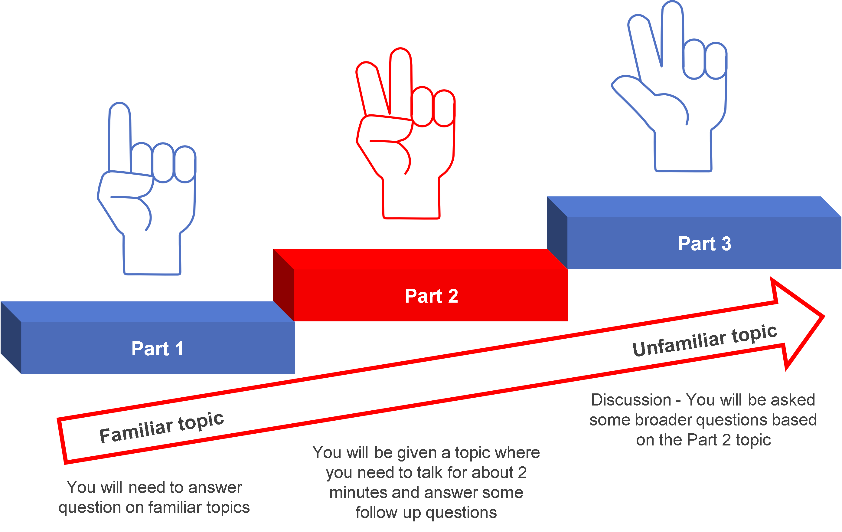
The Speaking test is the same for both the Academic and the General IELTS exams.
It could be on the same day as your Writing, Listening and Reading tests, which are taken together, or 7 days before or after them. All tests are recorded.
The Speaking Test lasts for 11-14 minutes and is made up of three parts.
Remember Speaking is even more personal than writing, and the idea of a speaking test is for the examiner to make you feel comfortable and at ease. They also have to give you every opportunity to show your speaking ability. But it is your job to show the examiner that you can speak both naturally and fluently.
Part 1: Introduction and Interview
Time: 4-5 minutes.
This section includes basic questions about familiar topics such as work, studies, hobbies, or daily routines. It helps the examiner assess your ability to communicate comfortably in everyday situations.
These questions will be easy to answer as you obviously know all about yourself and your life.
You cannot give a wrong answer so try to relax and treat this as a warm-up for the rest of the test.
Part 2: Individual Long Turn
Time: 3-4 minutes.
The examiner will give you a cue card with a topic written on it, along with 3-5 bullet points telling you what to include in your talk.
You will be asked to speak on this topic for up to 2 minutes. The examiner may then ask you 1 or 2 questions about your topic.
You’ll be given 1 minute for preparation during which time you are allowed to make notes.
The topic can be almost anything but will, again, be related to you in some way, for example:
- something about you
- something that has happened to you
- something you have experienced
Here’s an example of a cue card.
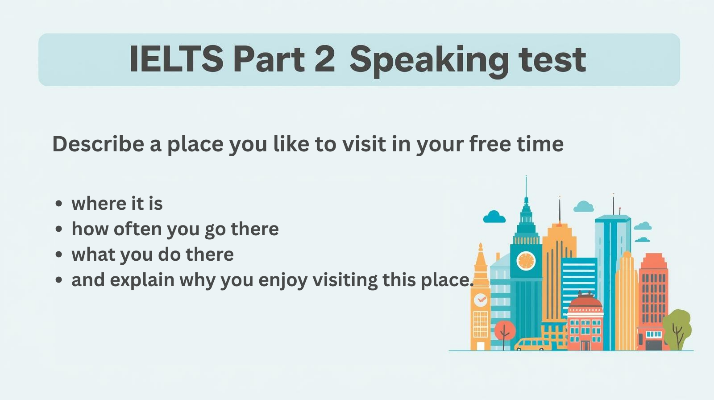
The topic of this IELTS Speaking Part 2 cue card is: Leisure / Free Time Places
More specifically, it falls under:
- Places
- Leisure activities
- Personal preferences
In simple terms, the cue card asks you to talk about a place you visit for relaxation or enjoyment during your free time, such as a park, café, library, beach, gym, or any location you like going to outside of work or study.
This is a very common IELTS Speaking topic, and it is designed to test your ability to:
- Describe a place clearly
- Talk about habits (how often you go)
- Explain activities and personal reasons
The 3 bullet points and final clause are a guide as to what you should talk about but you don’t have to stick rigidly to them.
Part 3: Discussion Questions
Time: 4-5 minutes - Two-Way Discussion
The examiner will ask you questions related to the topic on your cue card that you discussed in Part 2. These questions will be more abstract in nature to encourage you to explore ideas and concepts rather than just relating facts.
This will be more of a dialogue between you and the examiner which will give you the opportunity to express your thoughts and feelings about the topic or develop your ideas.
For this Leisure / Free Time Places topic, they will be questions such as:
Why do people need places to relax in modern society?
How has free time changed compared to the past?
Do you think technology has improved how people relax?
Practice Tip
Use simple structures to explain opinions:
- I believe that…
- One reason is…
- For example…
Common IELTS Speaking Mistakes to Avoid
- Giving very short answers
- Memorizing scripted responses
- Overusing complex vocabulary incorrectly
- Speaking too fast due to nervousness
- Stopping completely when making a mistake
Remember: Self-correction is allowed and sounds natural.
What the Examiner Is Actually Looking For?

To perform effectively in the IELTS Speaking test, you must understand the specific metrics used by examiners to evaluate your performance. Your final band score is determined by four distinct criteria, each contributing exactly 25% to your total mark. By focusing on these four areas, you can align your preparation with the official standards of the exam.
1. Fluency and Coherence
These two elements work together to measure the quality of your oral communication.
- Fluency: This refers to your ability to maintain a continuous flow of speech at a natural pace. High fluency means speaking easily without excessive searching for words, frequent self-correction, or long pauses that disrupt the listener.
- Coherence: This focuses on the logical structure of your answers. It assesses how well you organize your ideas and use linking words to ensure your points are connected and easy for the examiner to follow.
2. Lexical Resource (Vocabulary)
This criterion measures your ability to use a wide range of vocabulary accurately and appropriately.
A common misconception is that you must use highly advanced or “academic” words to achieve a high score. However, the most important factor is contextual accuracy. Using complex words incorrectly often leads to unnatural speech that is difficult to understand, which can lower your score.
The examiner is looking for a “natural” speaker who chooses the most suitable words for the topic at hand. You should aim to sound like a proficient communicator in an everyday setting rather than a professor delivering a formal lecture. Prioritize using the right words for the specific question over attempting to use the most difficult words you know.
3. Grammatical Range and Accuracy
Grammar is often overcomplicated by candidates, but it should be approached with three key principles in mind:
- Avoid over-complication: Do not force complex structures if they do not fit the context.
- Appropriateness: Use the grammatical forms that most naturally answer the specific question asked.
- Tense Management: The questions are specifically designed to see if you can correctly navigate different tenses (past, present, and future).
While you need to demonstrate that you can use a variety of structures, your speech must remain coherent. Forcing multiple tenses into a single answer where they do not belong will make your response sound disjointed and may result in lost marks.
4. Pronunciation
The primary goal of pronunciation is clarity. If the examiner struggles to understand your words, they cannot accurately assess your level of English. Clarity is generally determined by five key features:
- Individual sounds: The correct articulation of vowels and consonants
- Word stress: Placing emphasis on the correct syllable within a word
- Sentence stress: Emphasizing the key words within a sentence to convey meaning
- Connected speech: How your words flow together in natural conversation
- Intonation: The rise and fall of your voice to indicate emotion or question types
While significant errors in grammar or vocabulary can hinder understanding, strong pronunciation acts as the foundation that allows your other language skills to be clearly recognized.
Final Thoughts
The IELTS Speaking test is designed to reflect real-life communication, not scripted performance. Understanding the test format and scoring system allows you to express your ideas confidently and clearly. With consistent practice and the right approach, achieving a strong Speaking band score is entirely achievable.