
Do the sections take place in a certain order?
Before June 2022 the order of IELTS was:
Listening, Reading, Writing and Speaking.
The new order of test for candidates appearing for Paper based exam is

For computer-based test, the order will remain as:

Are all of the tests on one day?
You will always take writing, reading and listening on the same day (in that order) for paper-based exam and listening, reading and writing for computer-based exam
The test is usually conducted in the morning or afternoon without any breaks between them
The IELTS speaking is a face-to-face interview with an examiner, it may be scheduled on the same day as the other parts of the test or on another day. Up to TWO DAYS BEFORE the other tests or SEVEN DAYS AFTER.
It is in your interest to inform the IELTS test organiser, if you are travelling to a test centre in another city, so that they can try to arrange your speaking test on the same day as the other parts of the IELTS exam.
Which exam is more difficult: General IELTS or Academic IELTS?

This is the most widely asked question by all the students who prepare for IELTS.
There is no difference between General Training and Academic IELTS in the Speaking and Listening sections.
The only difference between General Training and Academic IELTS is in the Reading and Writing parts.
From our extensive experience of teaching, IELTS Academic is thought to be somewhat more challenging, especially Reading. But in Reading you will need fewer correct answers to get a higher band score. For example: 32 marks = Band 7.0.
On the other hand, IELTS general is believed to be a bit easier, but in certain sections (Reading) will need more marks to achieve a better result. For example: 32 marks = Band 6.5.
How much does the IELTS exam cost?
Both British Council or IDP have a set fee for its test. At the time of writing this blog, the rates are
IELTS (Academic & General Training) – £155 to 200 (Rs15,750 for Paper based and Rs15,500 for Computer delivered in India).
It is always important to verify the cost of the exam before you register
How many test dates are there for the IELTS exam?
Generally, the IELTS exam is available to be taken at least 4 times a month. IELTS candidates can choose any of the 48 dates for the exam to take their test. There is no limit to the number of times a test can be taken.
How soon can I retake the IELTS exam?
There is no limitation on how many times you can sit the IELTS as long as your test centre can provide enough exam dates.
Should I retake the IELTS exam?
If your last IELTS certificate is more than 2 years old, and you need to submit a score to be admitted to college, to apply for work or migration, then YES, you need to resit the IELTS exam. The exception is that, if you’re applying for Australia Immigration, then the IELTS certificate is valid for 3 years.
What if I don’t like my IELTS results, can they be changed?
- Yes, you can apply for a re-evaluation (called EOR – Enquiry of Results) within six weeks from your test date. You will have to pay a fee (Rs11.500), which will be refunded only if your results are changed.
- It may take from 2 to 21 days, depending how many test segments you have requested to be reassessed. After this reassessment, you will not be able to request another re-mark,
- You can find out more about appealing the results of your exam results here, on the official British Council and IDP IELTS website. The ieltsclasses team wish you all the best of luck in your International English Language Testing Exam and hope our materials, advice and tips will help you achieve your desired band scores that will get you one step closer to your dream.
Should I take the paper-based test or the computer-based test?
Honestly, a lot of students feel that Computer delivered test is easier than Paper-based test! This is NOT TRUE, because the components and the level of difficulty of the computer-based test and the paper test are the same. Also, the question types and the marking criteria for both tests are also exactly the same.
The only other thing to consider is that the computer test is slightly more expensive, but you do get your results more quickly. If you sit the paper-based test, it always takes 13 days to receive your results, but it only takes up to 7 days for the computer-based test (and is often even sooner).
However, since there are minor differences between the paper-based test and Computer delivered test, you can practice both these test types and decide which one suits you best. The minor differences between Paper-based and Computer delivered test are:
- Reading – Computer delivered test, the passage is displayed on the left of the computer screen and the Questions on the right side of the screen, so it’s easier to scan and skim the passage, BUT detail reading could be a little problem. However, you are allowed to highlight whatever contact you wish to, so I guess, this could help.
- Writing – There is no spell checker in the computer delivered test, so you’re more likely to make spelling mistakes, and particularly have errors on your subject/verb agreements and punctuations.
- Listening- The way the questions and answers are displayed is the same as reading. However, when selecting the answers – it is easier, and you are less likely to be.
In short, in terms of what you are being tested on and how your results are calculated, the IELTS computer-based test and the traditional paper test are EXACTLY THE SAME.
My advice would be to try both to see which one you are more comfortable with.
How long does it take to prepare for IELTS?
In my experience, the amount of time a student needs to prepare for IELTS depends on their level of English, so It is important to have your English assessed first, so that adequate time can be allocated towards preparation, and this will certainly stop you from wasting time, effort and more importantly money!
The average length of time a student taught in English medium or Vernacular medium takes.
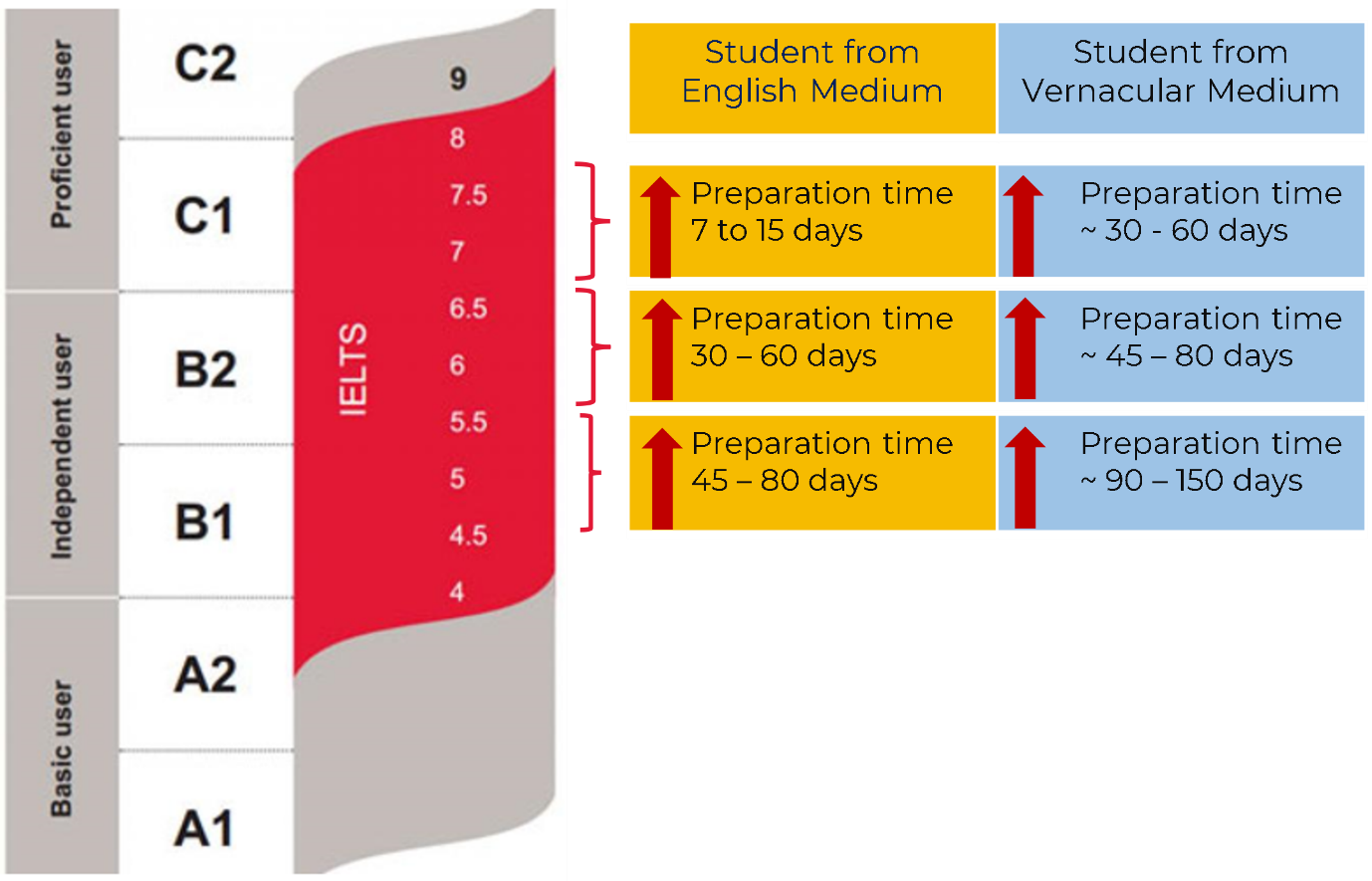
This is a general guide from my experience of teaching students from India. But it is advisable that before you leap into preparing for your IELTS exam, get yourself assessed for your level of English by a professional English teacher. This is surely a much better approach, as you will end up spending your time and energy on more constructive way to achieve your target IELTS score and save money too!
I hope that you found this introduction to IELTS useful and will now be better prepared to start your IELTS journey.
How to book your IELTS Exam?
- Find your nearest IELTS test centre. You can use the centre locator webpage on the official IELTS.org website here. IELTS BOOK A TEST
- Check the available dates and choose the date you want to take the test. and remember that as you will receive the results (a maximum of 13 days after the test date and 3-5 days after the computer delivered test the paper-based, it is important to select the date of test carefully to avoid disappointment.
- Then register online or download the application form and go to your test centre in person to apply. You can find more information about exam fees from the testing centre from IELTS BOOK A TEST. Remember, you can sign up for only one exam at a time,
- Copies of valid identity documents (for example, passport, national ID card, driving license, etc., but depends on the country) will be required from you at IELTS registration. The same ID will need to be presented on test day.
- Print the downloaded application form if you prefer. Fill in, attach a copy of your ID and submit it to the British Council or IDP office Online
- Pay online using one of the payment options outlined. Payment can be made with accepted credit or debit card.
- When your registration request is processed, you will receive an email with information about your upcoming IELTS exam: dates, time and location of each exam section.
- Read the emails you receive from your test centre very carefully: they also list important rules of the IELTS testing procedure that you must agree to and comply with.
- Try to get to your test venue at least 30 minutes before the test begins.
- Don’t forget to take your proof of ID – the same ID that you used for IELTS registration.
- Don’t forget that the Speaking section of the exam may be scheduled on a different day from the rest of the parts (Listening, Reading, Writing) - up to 7 days before or after them.
- To find out more information you can consult the Official IELTS Information for Candidates booklet – Introducing IELTS to test takers.